

One thing before we start. This article explains the French electronic invoicing reform. If you work in France, or sell to French businesses, it concerns you directly. If you don't, read it as a preview: several European countries have already been through this, and Yoplanning follows the rules of each country where it applies.
Today an invoice goes from you to your customer. A sheet of paper, or a PDF by email. Nobody else sees it.
Tomorrow it will travel through an official, state-approved service. You drop your invoice in, it hands it to your customer and passes the relevant information to the tax authority.
Think of it as an official post office: you no longer post your invoices yourself, you hand them to an authorised carrier who keeps a record of the delivery. You choose that service once, then you forget about it.
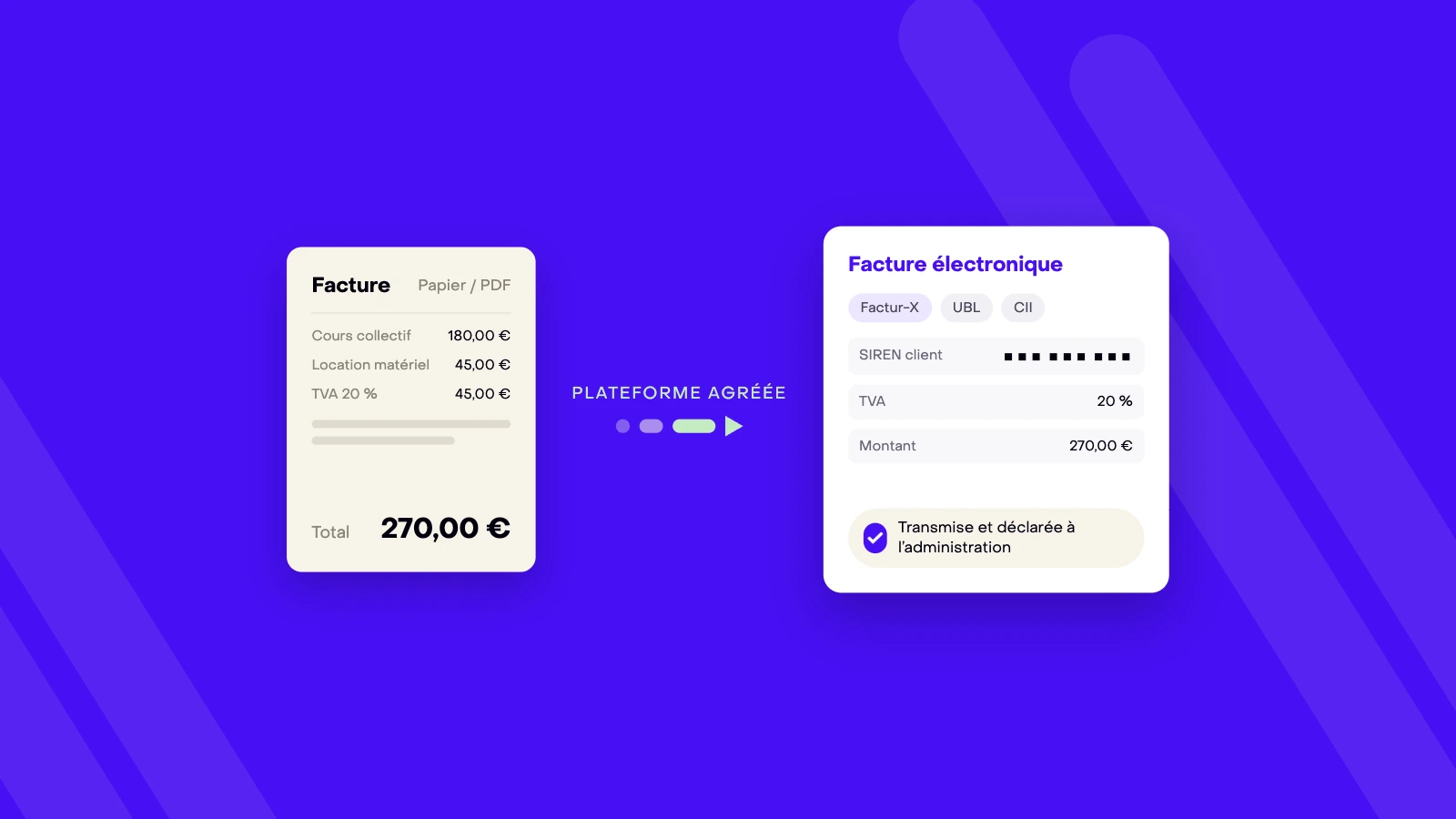
Does the invoice look different? No. It stays a PDF you open, read and print exactly as you do today. The difference is on the inside: the information is arranged so accounting software can read it automatically. No more amounts typed in by hand. The format is called Factur-X.
This is the distinction to hold on to, and the one that causes the most confusion.
In plain terms: this autumn is about opening a letterbox, not rebuilding your invoicing.
And if a customer announces they will no longer accept PDFs from September: every business follows its own legal deadline. A compliant invoice, for a real service, stays valid.
Here is the point almost nobody explains, and it is the one that saves you from panicking for nothing.
Everyone talks about « electronic invoicing ». But in our trades most of the revenue comes from private customers — and for those sales, an electronic invoice is not what is expected.
Three situations, three different obligations:
Why it matters: an instructor who reads « electronic invoicing becomes mandatory » pictures having to rebuild all their customer invoicing. In practice most of their activity comes down to a simple data transmission, which their tool does for them.
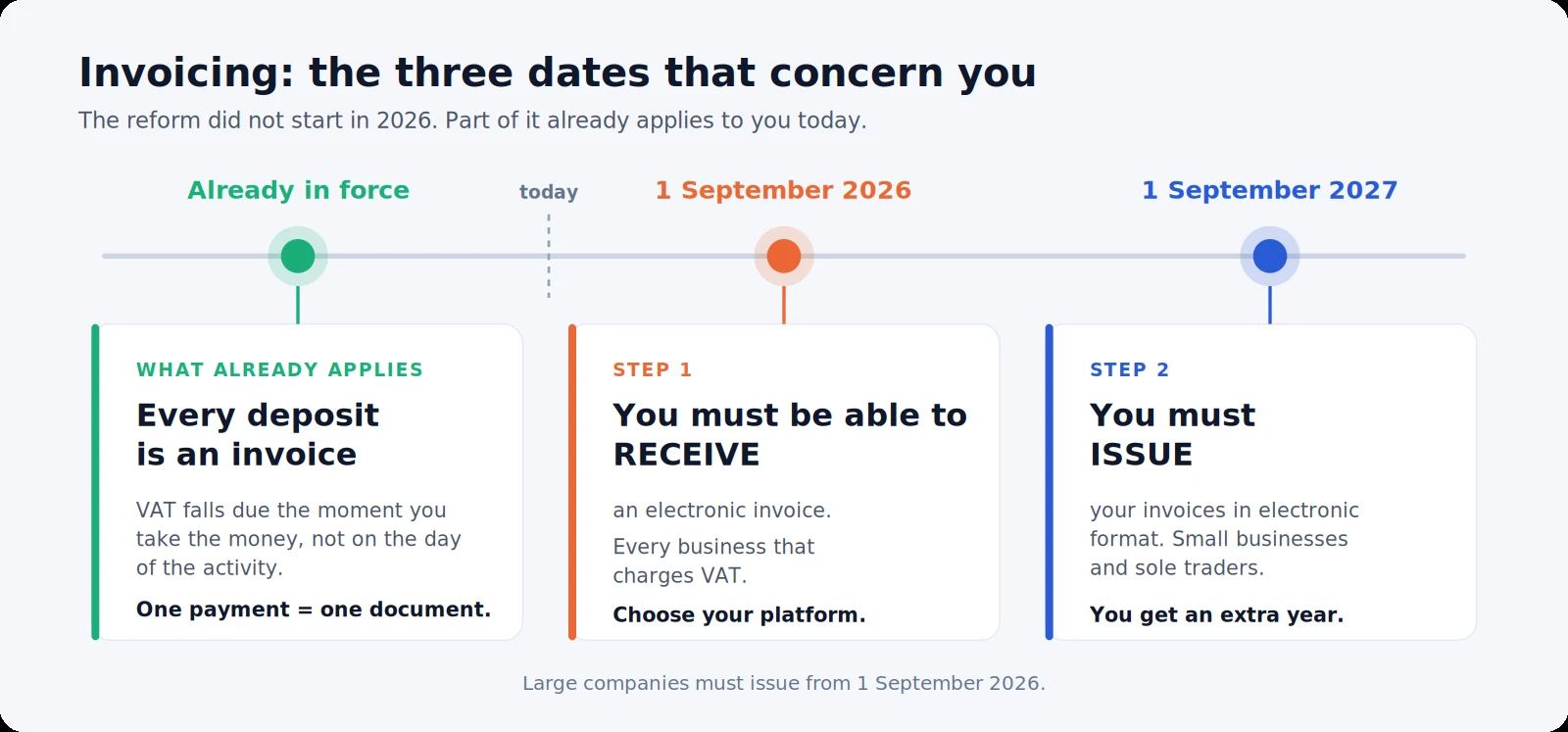
Sport and outdoor trades have three particularities: you take payment months in advance, you work with freelancers, and you settle the accounts at the end of the season. Those are the three points where the reform is felt.
1. Deposits become real invoices. A customer pays €90 in October for a course in February: a confirmation email is no longer enough. Every amount taken calls for a numbered, dated invoice, at the moment the money arrives.
Then, on the day of the course, a closing invoice restates the full price and deducts what has already been paid: €300 for the course, minus two €90 deposits, leaves €120. Nothing is erased, everything is traceable.
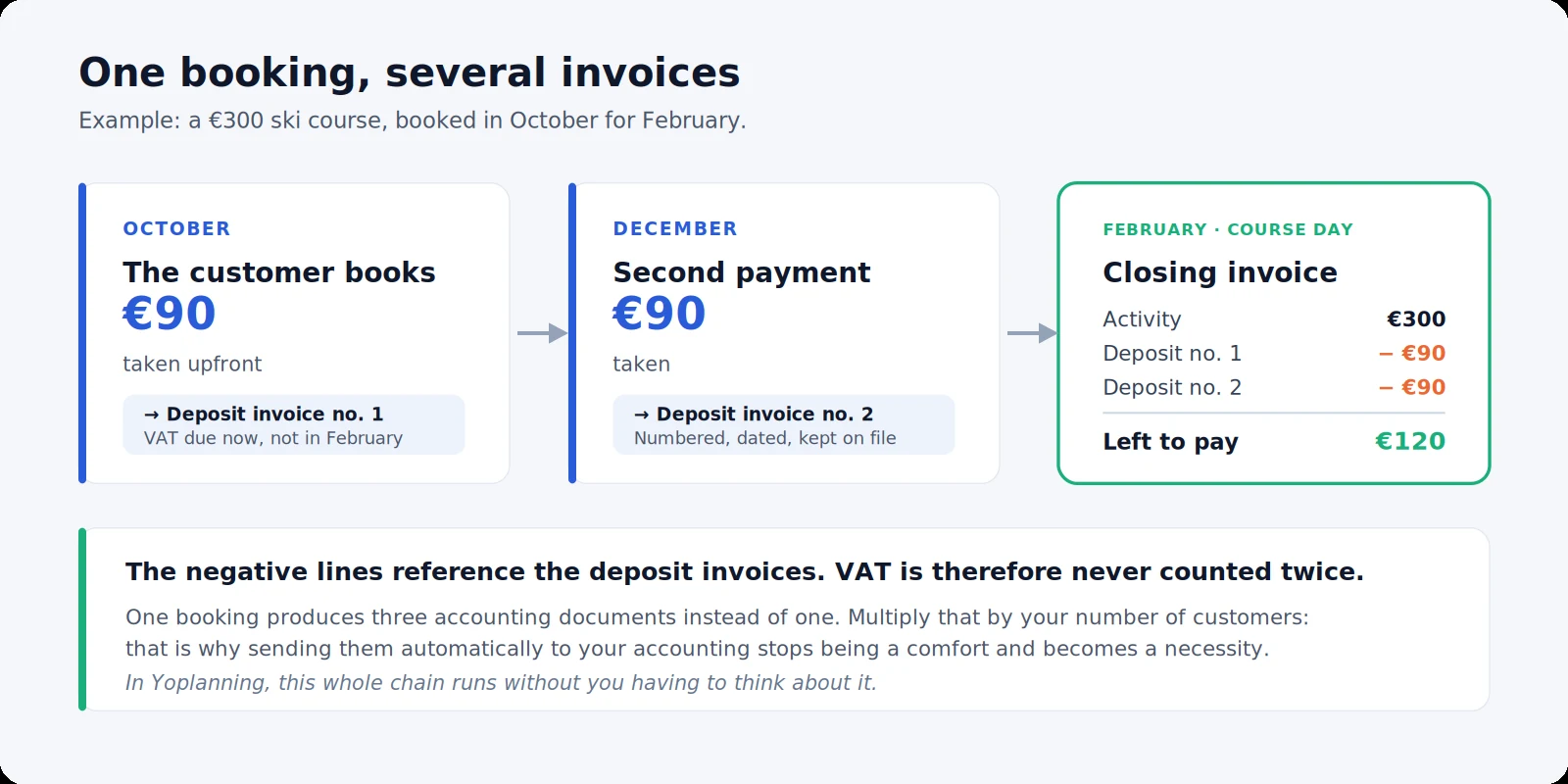
This is the most visible change day to day: a booking that used to produce one document now produces three. Across a full season, the volume becomes impossible to hold by hand.
2. The end-of-season adjustment will no longer do. In a ski school, a guide office or a whitewater base, the split between the business and its freelance instructors is often settled in spring, with the accountant.
From now on, the tax authority receives the information the moment the invoice is issued. Each invoice therefore has to state straight away what goes to the instructor and what stays with the business. The work is not heavier: it is simply spread out as you go — provided your invoicing tool knows how to do it.
3. Your freelance instructors are concerned too. A business receiving invoices from its seasonal instructors will need to be able to receive them through the official channel from September 2026. Same reflex as for your suppliers: know where they land, and who checks the mailbox.
4. Two details worth knowing.
Three links, and only one to handle day to day: the field.
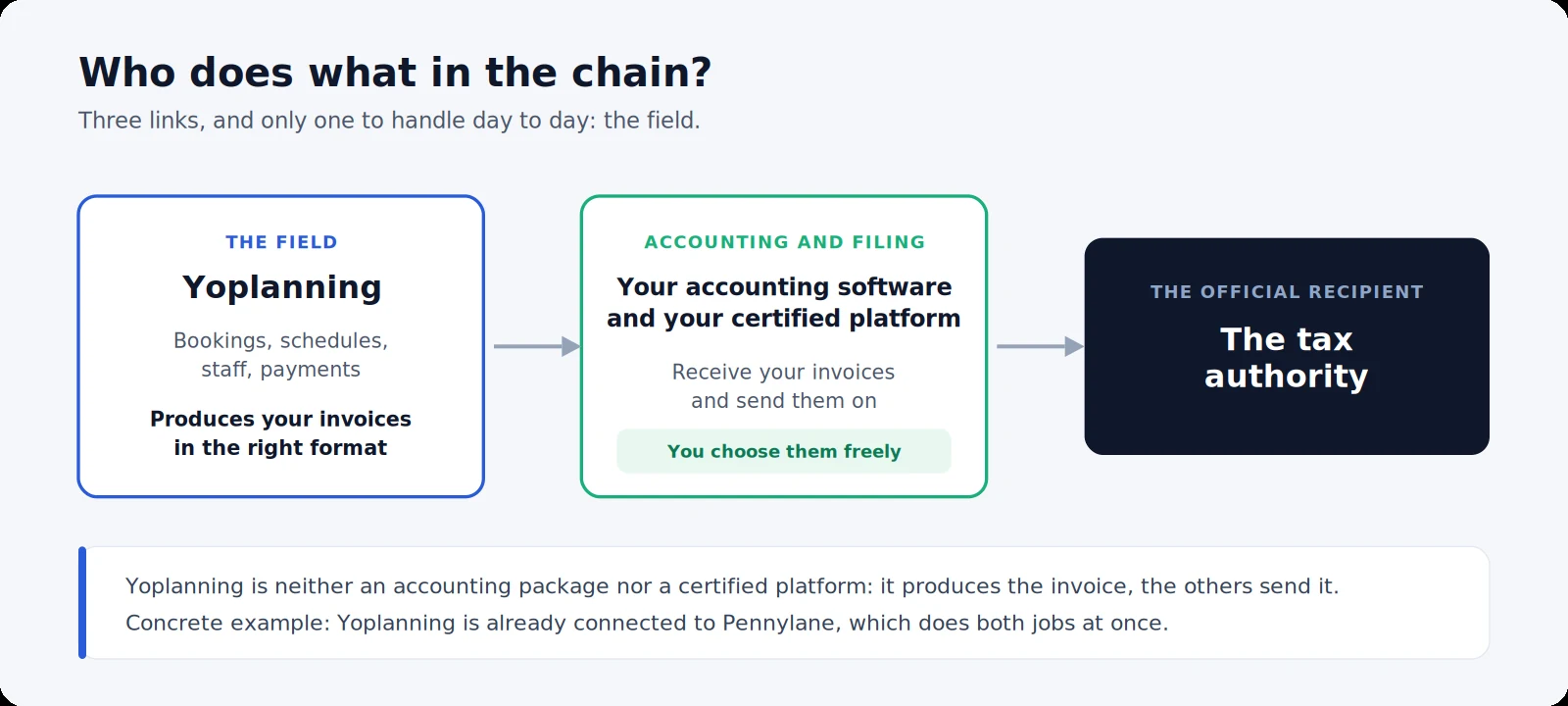
Yoplanning works where the activity happens: schedules, instructors, equipment, bookings, payments. That is where the invoices come from, already in the expected format, with deposits attached to the closing invoice and the split per instructor calculated from the moment of sale.
Your accounting software and your approved platform take over: they receive your invoices and handle the official transmission. You choose them freely, according to your habits and your accountant's recommendations.
A concrete example: Yoplanning is already connected to Pennylane, which is both accounting software and a registered approved platform. For a business using it, the chain is complete from the booking through to the tax authority, with no re-entry. With another accounting package, the principle is exactly the same.
What Yoplanning does not do: the VAT return, the legal retention of documents and the transmission to the tax authority. Those steps belong to accounting and to the approved platform.
Why Yoplanning follows this closely. Yoplanning issues invoices. As such, the tool is bound by the same formal requirements as you are: continuous numbering, retention, and the impossibility of altering a document once issued. Those rules are therefore built into the product. In the event of an audit, the supporting documents come out of Yoplanning.
The issuing deadline is in 2027, which leaves time. The benefit of acting early lies somewhere other than in meeting the calendar.
The reform does not add work: it spreads it out. What used to be handled in one block in spring gets handled a little each day. A business whose tools keep up barely notices. A business that waits discovers in February that a whole season has to be redone by hand.
Three concrete benefits for those who start early:
One last useful point: the tax authority distinguishes a business engaged in a compliance process from one that has done nothing. Having started, and being able to show it, counts.
· I mostly sell to private customers. Does this concern me?
Yes, but not in the way you would imagine. For those sales it is the transaction data that reaches the tax authority, not an electronic invoice. Your software handles it. Your sales to businesses, on the other hand, go through genuine electronic invoices.
· I am a freelance instructor. What should I do before 1 September 2026?
Choose an approved service to receive your suppliers' invoices, and check that every deposit you take produces an invoice.
· Do I have to stop paper or PDF invoices?
Not in 2026. The issuing deadline for small businesses is in 2027.
· A customer is refusing my PDF invoices. What do I say?
That every business follows its own legal deadline. A compliant invoice, matching a real service, stays valid.
· I take a deposit in October for a course in February. When do I invoice?
In October for the deposit, then on the day of the course for the balance. The second invoice deducts what has already been paid.
· This multiplies the number of invoices. How do I cope?
Through automation. It is the software's job to create the deposit invoices and pass them to accounting. In Yoplanning, that chain is automatic.
· What about my freelance instructors' invoices?
You will need to be able to receive them through the official channel from September 2026, like your suppliers'. They will have to issue them from September 2027.
· Our organisation is a non-profit. Is it concerned?
It depends on its tax position. Many non-profits in the sector have one part of their activity concerned and another that is not: that question is settled with an accountant.
· We are a guide office. What changes for the split with our freelancers?
It will have to appear on every invoice, at the point of sale, instead of being calculated at the end of the season.
· Do I need to change software?
Not necessarily. Three questions are enough to check: can it create deposit invoices, attach them to the closing invoice, and pass everything to accounting?
· Who chooses the approved platform?
You do. It is a free choice, and your accountant is best placed to advise you: many firms have already selected one for their clients. As an example, Yoplanning is connected to Pennylane, which is one of them.
· Does Yoplanning send my invoices to the tax authority?
No. Yoplanning produces them and sends them to your accounting, which handles the transmission through the approved platform of your choice.
Your season deserves better than a shoebox and a spreadsheet. Yoplanning — the partner behind your experiences.